Visual navigation ability is strongly tied to its underlying representation of the world. Unlike classical
3D maps that require globally-consistent geometry, image- or object-relative topological graphs almost
entirely do away with geometric understanding. But, this comes at the cost of navigation capability, often
limiting it to merely teach-and-repeat. In this work, we propose a novel map representation in the form of
pixel-relative connectivity, which is geometrically accurate but does not require global geometric
consistency.
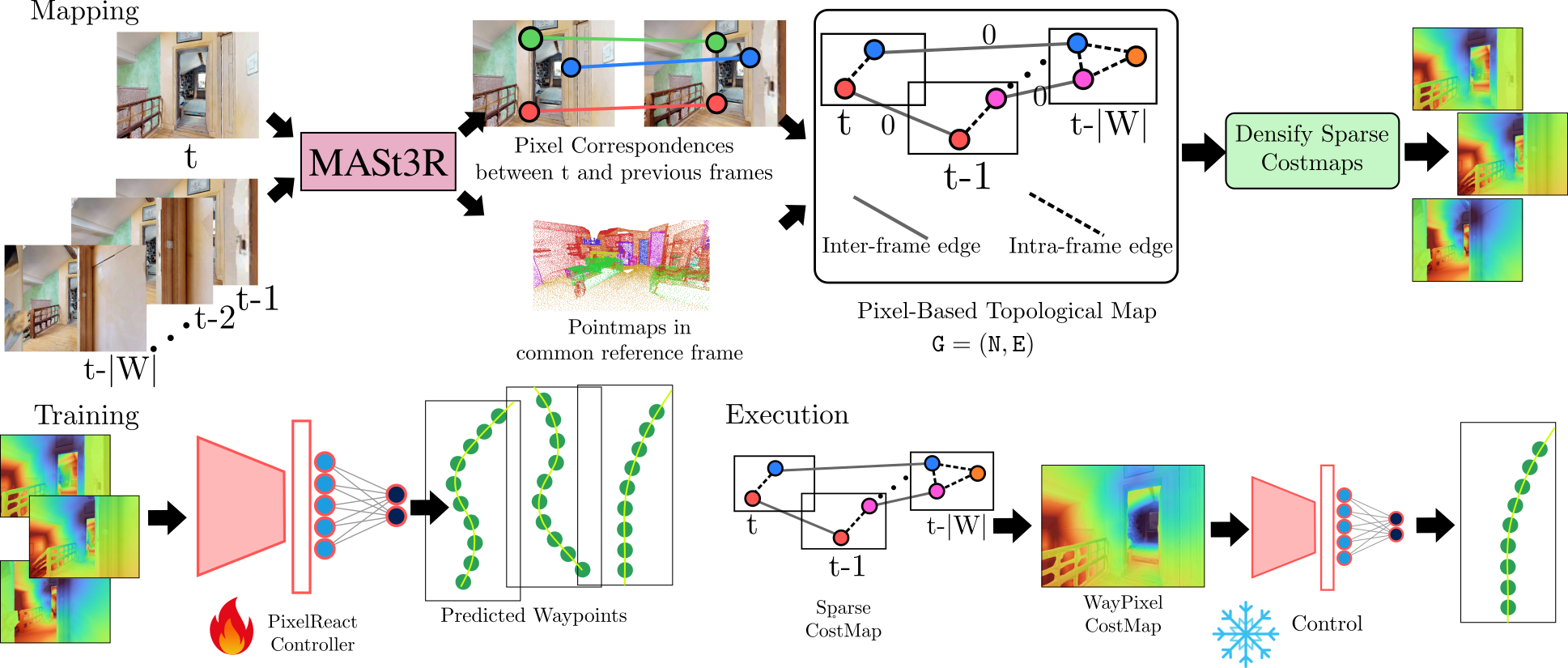
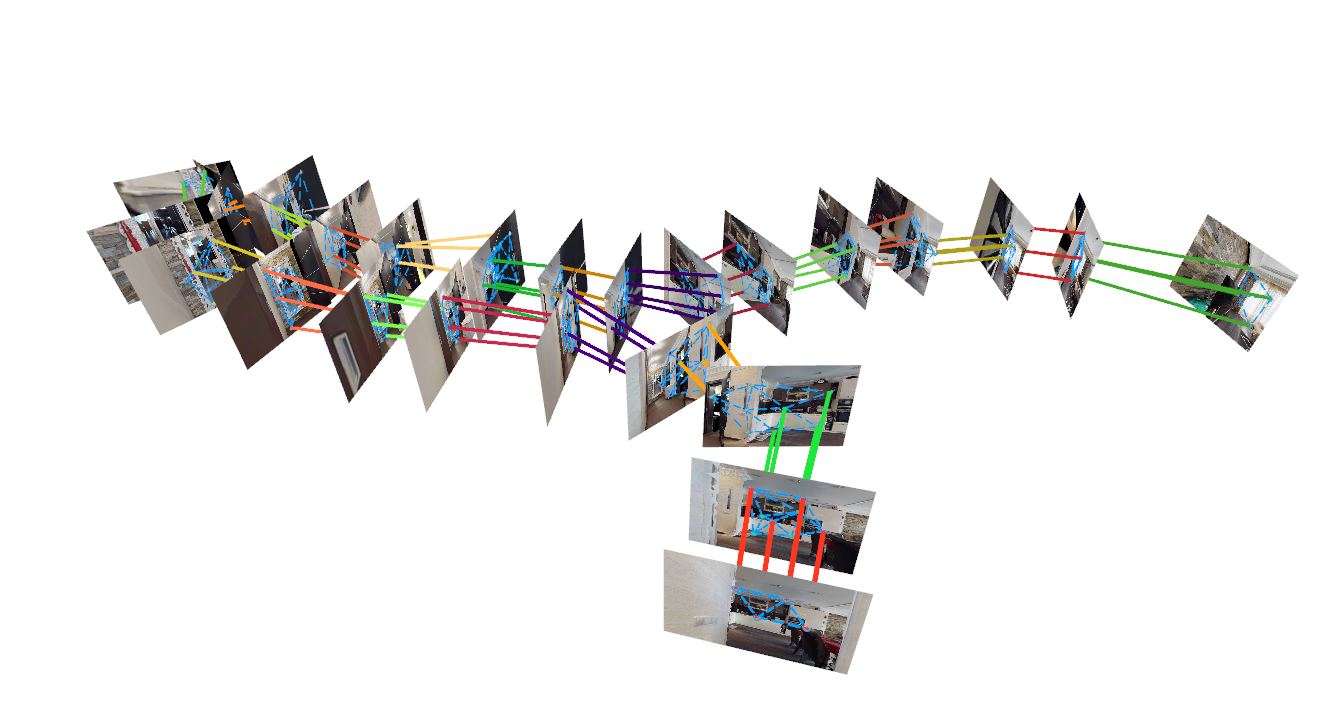
Inspired by recent progress in 3D grounded image matching, we construct a map from an image sequence
through inter-image connectivity based on pixel correspondences in the relative 3D coordinate systems of
individual image pairs. We then use this pixel-level graph to perform global path planning by
approximating and sparsifying intra-image pixel connectivity. Through this, we derive a
"WayPixel Costmap" representation and train a controller conditioned on it to predict a
trajectory rollout.
We show that this dense pixel-level costmap based on relative geometry is a more accurate conditioning
variable for control prediction than its image- and object-level counterparts. This enables a highly
capable navigation system, as validated on four types of navigation tasks in the simulator and through
real world demonstrations.